During 21JPSI’s first five years (2018-2023), four new courses were introduced to the Hamilton Lugar School/EALC Department curriculum, significantly expanding the school’s offerings on contemporary Japan. Between 2025 and 2028, current plans call for an *additional* 5-7 courses to be newly offered under 21JPSI’s aegis. This is in addition to numerous opportunities for students to be exposed to related issues through both 21JPSI’s student-centered event series and numerous additional courses on contemporary East Asia taught by 21JPSI-affiliated faculty that include significant Japan content but which are not Japan-specific.
The net effect of this ambitious curricular development is that Indiana University is on track to rank near—if not at—the top of all U.S. universities in terms of the number of courses available to students related to contemporary Japanese politics, society, and international affairs.
With the goal of reaching as many students as possible, none of these courses have prerequisites and all are open to students without regard to Japanese language ability. To further extend their reach to students who may not typically take courses focused on East Asia, many are also joint-listed or offered in other departments. Enrolled students not only learn about Japan in the classroom; they are also given special opportunities to meet with leading Japan experts coming to IU to speak in 21JPSI events.
The courses below appear in chronological order, based on the semester in which they were first offered.
Courses newly offered under 21JPSI’s aegis during the 2018-23 period
This course introduces students to the history and politics of U.S. - Japan relations in a regional and global context, with a particular focus on contemporary challenges confronting leaders in Tokyo and Washington—from the rise of China and trade frictions to base politics, climate change, and manifold security issues confronting the treaty allies. Students investigate the historical background and contemporary sources of these challenges and critically evaluate U.S.’ and Japan’s policy responses. (Instructor: Prof. Adam Liff; offered in Fall 2018; Spring 2022; Fall 2025; planned for Fall 2027)
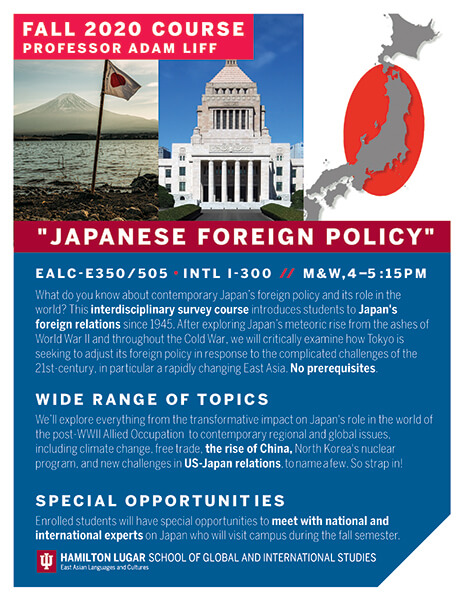
This course introduces students to the evolution of Japanese foreign policy since World War II, with particular attention paid to Japan's postwar relations with mainland China, North and South Korea, Southeast Asia, Taiwan, and the United States. They end the semester critically examining how Japan's leaders are seeking to adjust Tokyo’s foreign policies in response to the increasingly complicated challenges of the 21st century. (Instructor: Prof. Adam Liff; offered in Fall 2019; Fall 2020; Fall 2022; Fall 2024; planned for Fall 2026)
This course introduces students to the numerous domestic political and social challenges facing Japan in the 21st century. From the world's most rapidly aging society to the challenge of bringing more women and immigrants into the workforce, Japan's political leaders have struggled to effectively address a number of vexing domestic issues. Students investigate the sources of these challenges; identify their political, economic and social externalities; and evaluate Japan's policy responses. As a survey course on contemporary Japanese politics and society, this seminar covers a wide range of topics—e.g., Japan's political institutions and the constitution revision movement, to gender, immigration, demographics, and the role of the media. (Instructor: Prof. Hilary Holbrow; offered in Spring 2021; Spring 2023; Spring 2024)
This course explores how ideas of gender and sexuality in Japan have been profoundly shaped by larger social, economic and political forces. Although we often think of gender and sexuality as intimate aspects of our identity, these larger forces play an important role. Questions we will critically engage include: What does it mean to be a man or a woman in contemporary Japan? How have gender roles changed over the course of Japan’s modern history? In what ways have Japanese people embraced or resisted normative gender roles? (Instructor: Prof. Hilary Holbrow; offered in Fall 2021; Fall 2022; Spring 2024; Fall 2024; planned for Spring 2027)
Courses newly offered under 21JPSI’s aegis during the 2025-28 period
Many casual observers believe Japan to be a homogeneous country. In international comparison, accounts paint Japan as noteworthy for its lack of economic, cultural, linguistic, and ethno-racial diversity. This course unpacks the narrative of homogeneous Japan, and explores diversity along a number of different axes. These include family forms, social class, sexual and gender identity, race, immigrant background, disability status, and regional identity and culture. We will see how these categories of difference are constructed in the context of Japanese society, and how individuals and groups navigate their lives across these categories of difference. (Instructor: Prof. Hilary Holbrow; offered in Spring 2025; planned for Spring 2026)
This course examines language in Japanese society through the lens of sociolinguistics. We will focus on Japanese language and consider other languages spoken in Japan. We will also develop familiarity with basic concepts in sociolinguistics and tools to understand language in use. Topics include Japanese language variation, standard language and regional dialects, honorifics and politeness language, gendered language, indigenous and minority languages. Previous knowledge of Japanese or of sociolinguistics is not required; all course readings, discussions, and assignments will be conducted in English. (Instructor: Prof. Jae Takeuchi; offered in Spring 2025; planned for Spring 2026)
According to rankings by the World Economic Forum, Japan is one of the most gender unequal countries in the world. Purported policy solutions, such as generous provisions for paid parental leave, greater access to daycare, and initiatives to increase men's share of household labor have had lackluster results. In this course, we use secondary sources, and novel micro-data from large Japanese firms to investigate the extent of gender inequality and its causes. Student will engage with several stages of the research process, including identifying new research questions, literature review, and quantitative data analysis and visualization. (Instructor: Prof. Hilary Holbrow; offered in Spring 2025)
Japan is at the forefront of a global trend of population aging and decline. Currently the only large, developed country with a declining population, over the course of the 21st century, dozens of other countries in Asia, Europe, and Latin America are expected to begin shrinking as well. This makes Japan an important case for understanding the radical changes societies will experience as the exponential global population growth of the past three centuries begins to reverse itself. The aims of this course are three-fold: first, to understand how Japanese institutions, including the family, the education system, the employment system, the government, and social movements of ordinary citizens were formed and how they function today; second, to consider how these institutions pattern the lives of Japan’s residents; and third and finally, to explore how Japan, and other countries facing demographic decline, are likely to change in the coming decades as the world moves towards negative population growth. (Instructor: Prof. Hilary Holbrow; offered in Fall 2025; planned for Fall 2026)
This course frames the history, present and future of Japanese society in anthropological perspective. The course explores anthropological research on Japanese ethnic and national identity; gender and education; and the impact of changes in Japan’s economic fortunes on attitudes towards social selves and "others", work, play, consumption, and travel overseas. The principal learning outcome of this course is to become conversant with anthropological, historical, cultural theoretical and other representations of “traditional” Japanese society appreciated on its own terms but also as a context for further, and focal, explorations of Japanese social life and cultural production today, such as reflected in manga, animation, film, music, sports, fashion and cuisine. The course similarly explores the social, economic and political terms under which these cultural expressions have spread globally, as well as Japan's engagements with foreign culture in the U.S. and other regions. (Instructor: Prof. Marvin Sterling; offered in Spring 2026; planned for Spring 2027)
Details TBD. (Instructor: TBD; planned for Spring or Fall 2027)
Details TBD. (Instructor: TBD; planned for Spring or Fall 2027)
In addition to the above courses focused specifically on contemporary Japanese politics, society, and/or international relations, the EALC Department also offers many other courses on Japan from other perspectives (e.g., language, humanities). Additionally, numerous course offerings with an East Asia regional focus also incorporate significant Japan-related content.
Please check out EALC’s current course offerings through the link below.